Digital menu for restaurants
Ementa do Dia: dishes, QR codes, HACCP records and invoices in one dashboard. An application in use at Merendinha do Arco, with a public demo for other restaurants.
View site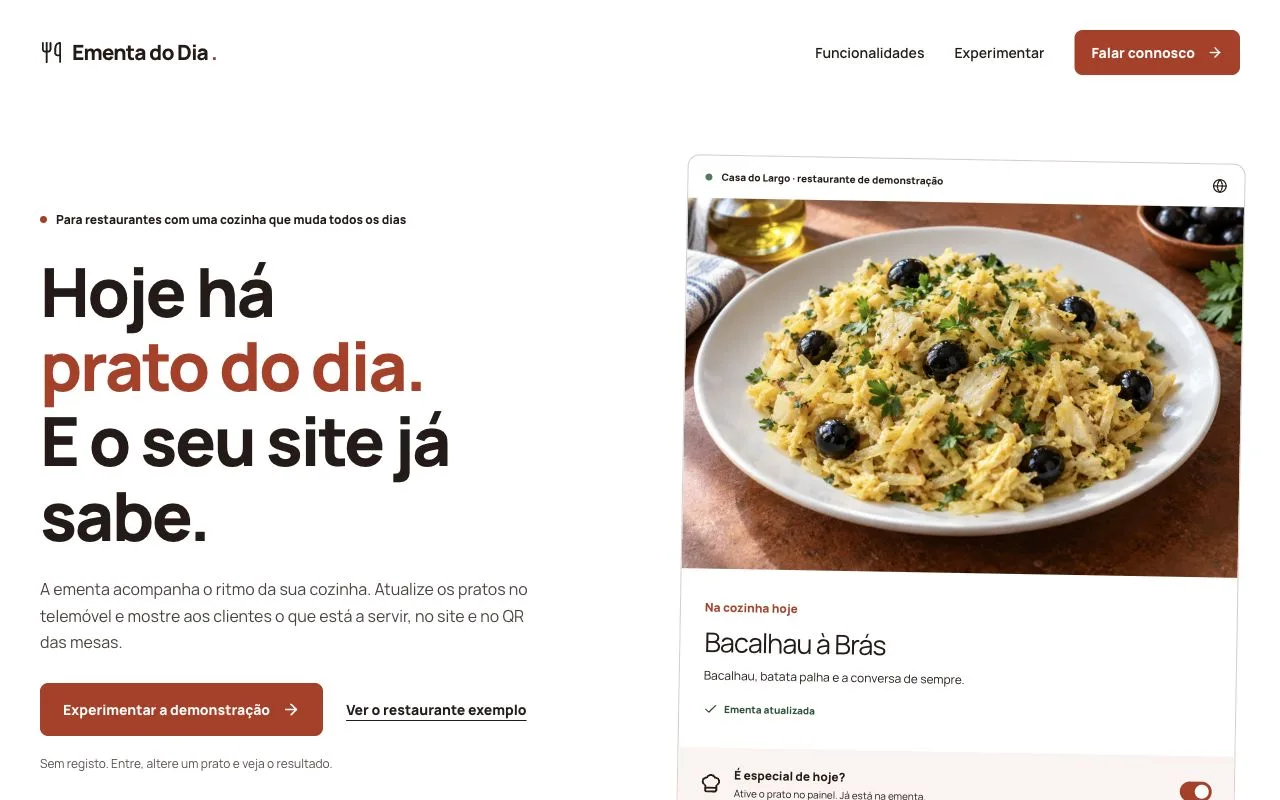
The problem
Merendinha do Arco is a traditional Portuguese restaurant in central Lisbon. The challenge was never putting the menu online — it was keeping it true. Daily specials change, prices change, and photos age. A PDF behind a QR code solves day one and creates work on every day after: re-export the file, make sure the right version is live, then repeat it in every language.
And many diners are tourists: names like pataniscas de bacalhau or choco frito mean nothing to someone arriving from abroad.
Then there is the part no customer ever sees, and that eats time every day: the food-safety records. In a traditional restaurant, fridge and freezer temperatures typically live on a sheet taped to the door and in a binder. The record exists, but it isn't alive — nobody knows Tuesday's reading is missing until someone leafs through the pages, and by then there is nothing to be done about it.
What I built
Ementa do Dia brings the digital menu and day-to-day restaurant management into one dashboard. It is in use at Merendinha do Arco in Lisbon. The public presentation includes a demo with the fictional Casa do Largo restaurant.
I built the menu as a living system, not a document. Each dish is managed on its own — name, description, price, availability, allergens and photo — and changes appear the moment they're saved. Daily specials can be shown or hidden without rebuilding the menu.
It runs in several languages, with Portuguese as the source of truth, and AI helps draft translations and descriptions — always with human review before anything is published. It opens from a single scan: no app, no account, no personal data collected, on the restaurant's own address.
Over time it grew beyond a menu. The same panel took on HACCP: every piece of equipment with its own temperature limits, every reading classified automatically as compliant, warning or out of range, and every deviation calling for a corrective action. Add to that equipment calibrations, verification plans and an audit trail that only ever appends — never deletes. Readings are immutable by design: if it was out of range, it stays out of range, and what gets written on top is what was done about it. That is the difference between a system and a pencilled sheet, on the day someone asks to see the last six months.
There is also a built-in visit counter, so the owner can see how many customers open the menu, and a single home for the restaurant's invoices: send them once, they're stored for good, and every month they're forwarded automatically to the restaurant's accountant. One less manual task, every month.
In the end, what sits behind the QR code isn't a menu. It's the tool where the restaurant handles what changes every day — the menu, the records and the paperwork — instead of moving between paper, spreadsheets and three different apps.
Highlights
- 1QR code on the table — opens with no app or account
- 2Instant updates to dishes, prices and availability
- 3Multilingual, with Portuguese as the source of truth
- 4Photo and allergens per dish
- 5AI-assisted translations, always with human review
- 6HACCP records in the same panel — temperatures, corrective actions and calibrations
- 7Immutable readings and an audit trail — ready for an inspection
- 8Built-in visit counter — how many customers open the menu
- 9Invoices stored for good and auto-sent to the accountant every month
The result
Now, when a tourist arrives, the staff simply point them to the digital menu to understand what each dish is and what's in it — instead of explaining every plate at the table. It saves time, and in a small restaurant efficiency is what lets them give the experience to more people.
The daily specials — what changes most from day to day — are updated by the owner himself, on the day. And the same menu is the basis for printing the paper carta when needed.
“I have everything in the same system, and I'm much faster at entering the dishes of the day — I do it shortly before lunch.”
— Filipe, Merendinha do Arco · a traditional restaurant in central Lisbon
I wrote about the challenges of digitising a traditional menu in this article.